Roberto Crippa
Monza, 1921 - Bresso, Milano 1972
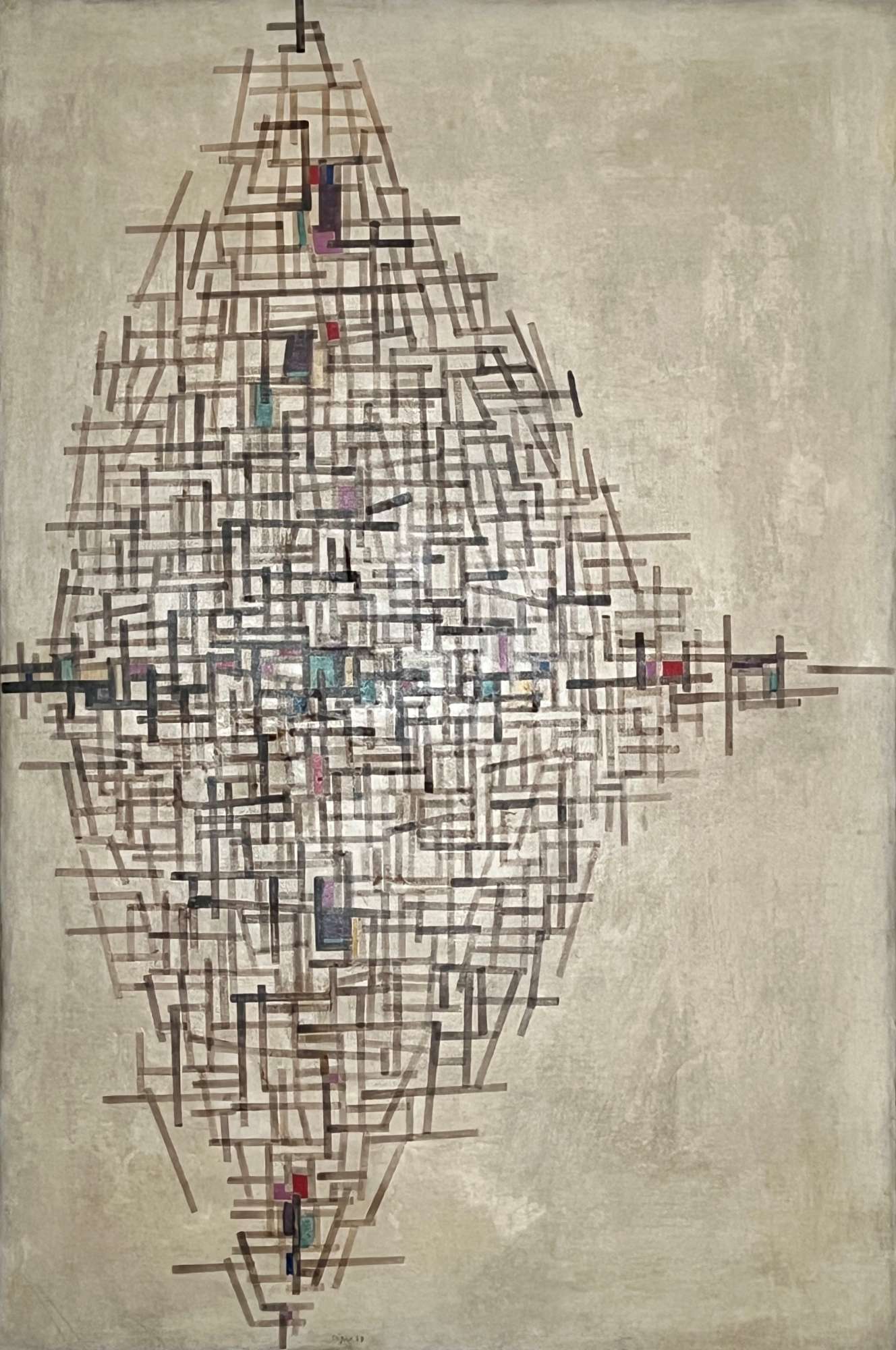
Crippa’s work at the beginning of the fifties was centered around a series of paintings called Spirals, of geometric and abstract character: with the geometric gesture almost-circular, but never perfectly round, Crippa created spaces involuted, from which rays were generated that ideally projected out of the two-dimensional nature of the canvas, in line with the principles of the "Manifesto" spatialist.
Gaetano Crippa was born in Monza on May 7, 1921. Driven by his passion for flying, he enlisted very young in the Italian Air Force participating in several war missions. He attended the Brera Academy of Fine Arts, where he was a pupil of Aldo Carpi, Achille Funi and Carlo Carrà. After starting painting in 1945, in figurative style with Cubist influences, he joined the Spatialism movement with Lucio Fontana, Gian Carozzi, Giorgio Kaisserlian, Beniamino Joppolo, Milena Milani, Sergio Dangelo, Carlo Cardazzo, Cesare Peverelli. After graduating in art in 1947 at the Brera Academy (where he met Aldo Carpi, Carlo Carrà and Achille Funi), he participated the following year at the Venice Biennale, and exhibited works at the Milan Triennale. Again in 1950, 1954 and 1956 he was present at the Biennale and in 1950 he exhibited in Trieste during a group exhibition entitled Arte spaziale. In addition, he was one of the signatories of the third "Manifesto of Spatialism" (Proposal for a Regulation) of 1950. In 1951 he also participated in the "Manifesto dell'Arte Spaziale". Crippa’s work at the beginning of the fifties was centered around a series of paintings called Spirals, of geometric and abstract character: with the geometric gesture almost-circular, but never perfectly round, Crippa created spaces involuted, from which rays were generated that ideally projected out of the two-dimensional nature of the canvas, in line with the principles of the "Manifesto" spatialist. Becoming known abroad for his works, Crippa went to New York where he met the surrealists Max Ernst, Victor Brauner and Yves Tanguy and exhibited at the gallery of Alexander Iolas. The Spirals changed, becoming heavier, incisive and involute, interlaced with each other. These figures, developed between 1954 and 1956, are called Totems. In 1955 he moved to the production of poly-material works, which populated a solo exhibition at the Naviglio gallery in Milan.
The following year, the inspiration of the polymaterial paintings was further developed, with the production of works in iron, bronze and steel inspired by primitive symbolism. With these works he participated in the Biennale of 1958. The use of original materials in 1960 resulted in the production of works in asbestos, cork, newspaper and tissue paper, combined with different materials and colors. The works were exhibited in a traveling exhibition that reached Japan, the United States and Australia. In 1962 he was the victim of a first flight accident that left him for a year in a wheelchair, but he participated with his paintings at several exhibitions in Europe and the United States. The following year the artist, fully recovered, participated in the Biennials of Venice and Menton. In this phase Crippa went on to paint landscapes (Landscape), with the polymaterial technique and with the usual abstract style. Also of this period are the asbestos, non-dipintis made with thin sheets of asbestos applied on an engraved board. In the seventies Roberto Crippa was also involved in postal art (mail art). In 1972, during a flight of preparation for the World Championships of aerial acrobatics, the plane of Crippa crashed near the airport of Bresso; the artist and his pupil Piero Crespi lost their lives.
The following year, the inspiration of the polymaterial paintings was further developed, with the production of works in iron, bronze and steel inspired by primitive symbolism. With these works he participated in the Biennale of 1958. The use of original materials in 1960 resulted in the production of works in asbestos, cork, newspaper and tissue paper, combined with different materials and colors. The works were exhibited in a traveling exhibition that reached Japan, the United States and Australia. In 1962 he was the victim of a first flight accident that left him for a year in a wheelchair, but he participated with his paintings at several exhibitions in Europe and the United States. The following year the artist, fully recovered, participated in the Biennials of Venice and Menton. In this phase Crippa went on to paint landscapes (Landscape), with the polymaterial technique and with the usual abstract style. Also of this period are the asbestos, non-dipintis made with thin sheets of asbestos applied on an engraved board. In the seventies Roberto Crippa was also involved in postal art (mail art). In 1972, during a flight of preparation for the World Championships of aerial acrobatics, the plane of Crippa crashed near the airport of Bresso; the artist and his pupil Piero Crespi lost their lives.