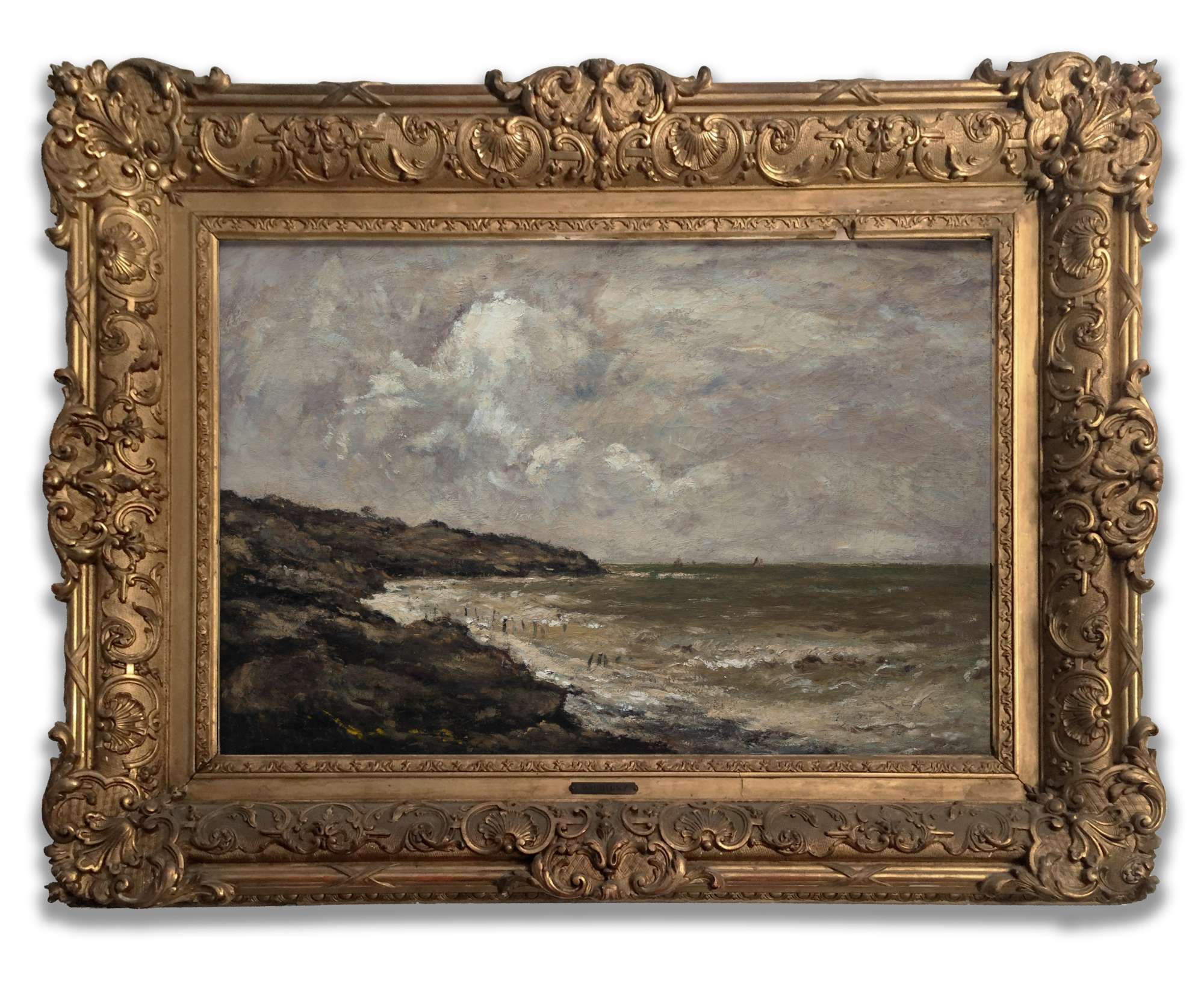
Karl Pierre Daubigny
Parigi,1846 - Auvers-sur-Oise, Francia, 1886
Karl Daubigny followed his father's teachings and also took en-plein-air painting to the highest level with the creation of water features, which shortly thereafter inspired the Impressionists. The artist's story, intertwined with the birth of the famous movement that his father patronized from the very beginnings of the exhibitions at the Paris Salon, taking its cue from the Barbizon school of landscape painting.
Karl Daubigny (1846-1886), son of Charles-François, continued in his father's tradition: if in his early days his father's example was very marked, we can say that the works of his maturity achieved a very personal and original style, characterized above all by the atmosphere and the plays of color and light, perfectly realized with pure colors.
He debuted at the Salon of 1863 with the works Le Sentier and L'Ile de Vaux sur l'Oise, which reveal in him a very intense feeling of nature, especially springtime.
He exhibited regularly at the Salons where he was awarded medals in 1868 and 1874. He painted mainly landscapes of Normandy and the forest of Fontainebleau.
Karl Daubigny followed his father's teachings and took en-plein-air painting to the highest level, which reaches its acme in the creation of water features, which shortly thereafter did not fail to inspire the Impressionists. In fact, the artist's story is intertwined with the birth of the famous movement (which his father patronized from the very beginnings of the exhibitions at the Paris Salon) by taking its cue from the Barbizon school of landscape painting, known for the naturalistic effects achieved by its members and for the normalization of open-air technique.
In making colors, the artist used only pure earths mixed with poppy oil (detectable by the heavy gray oxidation of the less stable blues and greens) and little highly volatile solvent; he intervened directly on the canvas preparation. Despite his untimely death, he remains in memory as one of the most "charming" landscape painters of the second half of the 19th century.
Museums:
Aix
Amiens
Bayonne
Berlin
Briest
La Hayne
Honfleur
Bibliography:
E. Bénezit, Dictionnaire critique et documentaire des Peintres, Sculpteurs, Dessinateurs et Graveurs, Paris, Librairie Gründ, 1976; G. Schurr, P. Cabanne, Dictionnaire des Petits Maîtres de la peinture, 1820-1920, Paris, Les éditions de l'amateur, 1996
He debuted at the Salon of 1863 with the works Le Sentier and L'Ile de Vaux sur l'Oise, which reveal in him a very intense feeling of nature, especially springtime.
He exhibited regularly at the Salons where he was awarded medals in 1868 and 1874. He painted mainly landscapes of Normandy and the forest of Fontainebleau.
Karl Daubigny followed his father's teachings and took en-plein-air painting to the highest level, which reaches its acme in the creation of water features, which shortly thereafter did not fail to inspire the Impressionists. In fact, the artist's story is intertwined with the birth of the famous movement (which his father patronized from the very beginnings of the exhibitions at the Paris Salon) by taking its cue from the Barbizon school of landscape painting, known for the naturalistic effects achieved by its members and for the normalization of open-air technique.
In making colors, the artist used only pure earths mixed with poppy oil (detectable by the heavy gray oxidation of the less stable blues and greens) and little highly volatile solvent; he intervened directly on the canvas preparation. Despite his untimely death, he remains in memory as one of the most "charming" landscape painters of the second half of the 19th century.
Museums:
Aix
Amiens
Bayonne
Berlin
Briest
La Hayne
Honfleur
Bibliography:
E. Bénezit, Dictionnaire critique et documentaire des Peintres, Sculpteurs, Dessinateurs et Graveurs, Paris, Librairie Gründ, 1976; G. Schurr, P. Cabanne, Dictionnaire des Petits Maîtres de la peinture, 1820-1920, Paris, Les éditions de l'amateur, 1996