Emile Lahner
Velykyi Bereznyi, Ucraina, 1893 - Parigi, 1980
Emile Lahner was a Hungarian painter. He exhibited in Paris, New York, Boston; he participated in the Salon des Indépendants, the Salon des Tuileries and the first exhibition dedicated to the Ecole de Paris in Rio de Janeiro and São Paulo in Brazil. He paints landscapes, portraits, horses, acrobats and idealized nudes and performs the first abstract watercolors. It will pass from the abstract to the figurative and vice versa, depending on the inspiration of the moment. In the mid-1930s Lahner entered the "Post-Impressionist" phase, rejecting the objectivity of impressionist naturalism. He also travelled to Africa where he preferred to dedicate himself to market scenes, the arid countryside, the plain of Mitidja; He also executed drawings and designs for the stained glass windows of the chapel of El Affroun.
He spent his childhood in Hungary and, orphaned of both parents, was entrusted to a tutor who advised him to study engineering. His passion for painting led him to abandon his studies and in 1915 he enrolled him in the Ecole des Beaux-Arts in Budapest where he began painting. He initially followed the impressionist style of his teachers Kochine and Vaszary, but from 1915 to 1917 he was attracted by Futurist experiences and German Expressionism.
In 1923 he spent a short time in Zurich, then in Lausanne, where he discovered French painting: Delacroix, Monet and Van Gogh. After this experience, in 1924 he decided to move to Paris to study modern painting. He lives in the Latin Quarter and after about a year he moves to Montmartre. He frequents Montparnasse and the Ateliers Bourdelle, Colarossi and Grand Chaumière. In this period he painted "poetic" subjects: nudes, female figures, horses, with a paler palette than the works of the Hungarian years.
In 1927 he returned to Hungary where he exhibited for the first time, receiving the Ernst Prize. At the end of the Twenties, he travelled in the south of France: Sanary, Saint-Tropez, Saint-Paul-de-vence, where he painted bright landscapes and seas. The crisis of 1929 put many artists in difficulty, especially those not introduced in elite galleries. In 1931 Lahner moved to Montparnasse and was forced to perform humble work to survive. Despite the difficult situation the artist begins to achieve success. In 1930 he exhibited in Paris, New York, Boston; he participated in the Salon des Indépendants and in the first exhibition dedicated to the Ecole de Paris in Rio de Janeiro and São Paulo, Brazil. In these years he participated in the Salon des Tuileries.
He paints landscapes, portraits, horses, acrobats and idealized nudes and performs the first abstract watercolors. From now on it will pass from the abstract to the figurative and vice versa, depending on the inspiration of the moment.
At the outbreak of war, Lahner left Paris for Vichy, where he was a guest in the Averseng family’s castle. Explore the caves with primitive engravings of the Auvergne and Dordogne region from which he will take inspiration for a series of paintings.
In the mid-1930s Lahner entered the "Post-Impressionist" phase, rejecting the objectivity of impressionist naturalism and using forms and colors in a more expressive and personal way.
After the liberation in 1945, he returned to Paris and began to exhibit more frequently.
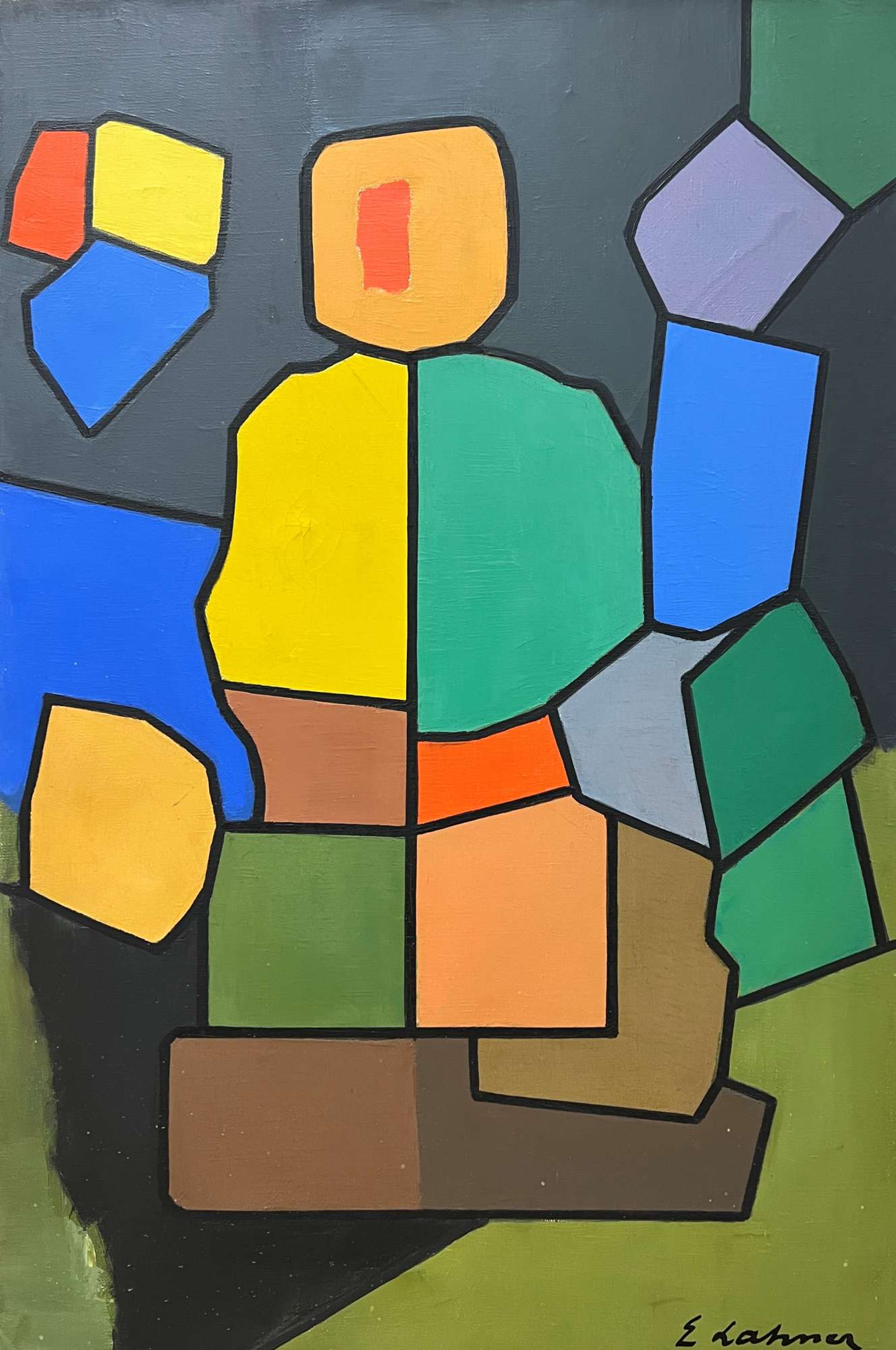
In 1948 he travelled to Algeria where he returned in 1952-53. In Africa he prefers to dedicate himself to market scenes, to the arid countryside, to the plain of Mitidja; he also performs drawings and projects for the stained glass windows of the chapel of El Affroun commissioned by the Averseng family. Even this experience has a significant impact on his art, in fact, both in abstract and figurative works, from now on he will often use wide backgrounds, surrounded by a black line reminiscent of the art of stained glass.
Lahner is also interested in engraving and publishes a collection entitled Formes, lignes, couleurs.
In the second half of the 1950s, two relationships influenced Lahner’s life: his marriage to Jeanne Cazenave and his close friendship with Laszo Laky, an art dealer of Hungarian descent.
In the spring of 1961 Lahner achieved enormous success with a solo show at the Galerie Jeanne Castel. His painting is increasingly abstract and less figurative. Although in these paintings he resorts almost totally to the geometric form, never fails the emotional, lyrical inspiration and balance that always characterizes every work. In the 1970s Lahner exhibited in Paris and, thanks to Laszo Laky, also in California, where the latter owns a gallery. With the profits he bought a small villa in Vence, on the French Riviera.
In recent years he returns to the roots of his painting, drawing new inspiration from Impressionism; maintaining this trend only light and colors, creates some of the most imaginative works of his career.
Exhibitions:
1930, Paris, Galerie Gilbert, group exhibition, 1-15 December;
1931, Paris Galerie Gilbert, collective exhibition, 15- 30 January;
1933, Paris, Galerie Vignon;
1936, Paris Galerie Bonaparte (with Daria Gamsaragan);
1950, Paris, Galerie Jeanne Castel;
1961, Galerie Jeanne Castel, Paris;
1964, Paris, Galerie Famar, 26 February-31 March;
1975, San Francisco, Maxwell galleries, 13 May-14 June;
1977, Paris, Galerie René Drouet, 4 May - 4 June;
1985, Paris, Mairie du xvie arrondissement, 19 February-3 March;
2004, Bergamo, Centro Culturale S. Bartolomeo, "Atelier cosmopolita, Paris, 1900-1970"
04.12.2005;
2007, Bergamo, Galleria Michelangelo, "Ecole de Paris 1950-'70", 15 February-15 March
In 1923 he spent a short time in Zurich, then in Lausanne, where he discovered French painting: Delacroix, Monet and Van Gogh. After this experience, in 1924 he decided to move to Paris to study modern painting. He lives in the Latin Quarter and after about a year he moves to Montmartre. He frequents Montparnasse and the Ateliers Bourdelle, Colarossi and Grand Chaumière. In this period he painted "poetic" subjects: nudes, female figures, horses, with a paler palette than the works of the Hungarian years.
In 1927 he returned to Hungary where he exhibited for the first time, receiving the Ernst Prize. At the end of the Twenties, he travelled in the south of France: Sanary, Saint-Tropez, Saint-Paul-de-vence, where he painted bright landscapes and seas. The crisis of 1929 put many artists in difficulty, especially those not introduced in elite galleries. In 1931 Lahner moved to Montparnasse and was forced to perform humble work to survive. Despite the difficult situation the artist begins to achieve success. In 1930 he exhibited in Paris, New York, Boston; he participated in the Salon des Indépendants and in the first exhibition dedicated to the Ecole de Paris in Rio de Janeiro and São Paulo, Brazil. In these years he participated in the Salon des Tuileries.
He paints landscapes, portraits, horses, acrobats and idealized nudes and performs the first abstract watercolors. From now on it will pass from the abstract to the figurative and vice versa, depending on the inspiration of the moment.
At the outbreak of war, Lahner left Paris for Vichy, where he was a guest in the Averseng family’s castle. Explore the caves with primitive engravings of the Auvergne and Dordogne region from which he will take inspiration for a series of paintings.
In the mid-1930s Lahner entered the "Post-Impressionist" phase, rejecting the objectivity of impressionist naturalism and using forms and colors in a more expressive and personal way.
After the liberation in 1945, he returned to Paris and began to exhibit more frequently.
In 1948 he travelled to Algeria where he returned in 1952-53. In Africa he prefers to dedicate himself to market scenes, to the arid countryside, to the plain of Mitidja; he also performs drawings and projects for the stained glass windows of the chapel of El Affroun commissioned by the Averseng family. Even this experience has a significant impact on his art, in fact, both in abstract and figurative works, from now on he will often use wide backgrounds, surrounded by a black line reminiscent of the art of stained glass.
Lahner is also interested in engraving and publishes a collection entitled Formes, lignes, couleurs.
In the second half of the 1950s, two relationships influenced Lahner’s life: his marriage to Jeanne Cazenave and his close friendship with Laszo Laky, an art dealer of Hungarian descent.
In the spring of 1961 Lahner achieved enormous success with a solo show at the Galerie Jeanne Castel. His painting is increasingly abstract and less figurative. Although in these paintings he resorts almost totally to the geometric form, never fails the emotional, lyrical inspiration and balance that always characterizes every work. In the 1970s Lahner exhibited in Paris and, thanks to Laszo Laky, also in California, where the latter owns a gallery. With the profits he bought a small villa in Vence, on the French Riviera.
In recent years he returns to the roots of his painting, drawing new inspiration from Impressionism; maintaining this trend only light and colors, creates some of the most imaginative works of his career.
Exhibitions:
1930, Paris, Galerie Gilbert, group exhibition, 1-15 December;
1931, Paris Galerie Gilbert, collective exhibition, 15- 30 January;
1933, Paris, Galerie Vignon;
1936, Paris Galerie Bonaparte (with Daria Gamsaragan);
1950, Paris, Galerie Jeanne Castel;
1961, Galerie Jeanne Castel, Paris;
1964, Paris, Galerie Famar, 26 February-31 March;
1975, San Francisco, Maxwell galleries, 13 May-14 June;
1977, Paris, Galerie René Drouet, 4 May - 4 June;
1985, Paris, Mairie du xvie arrondissement, 19 February-3 March;
2004, Bergamo, Centro Culturale S. Bartolomeo, "Atelier cosmopolita, Paris, 1900-1970"
04.12.2005;
2007, Bergamo, Galleria Michelangelo, "Ecole de Paris 1950-'70", 15 February-15 March